First project about concurrent programming at 42 school: implementation of the "dining philosophers problem".
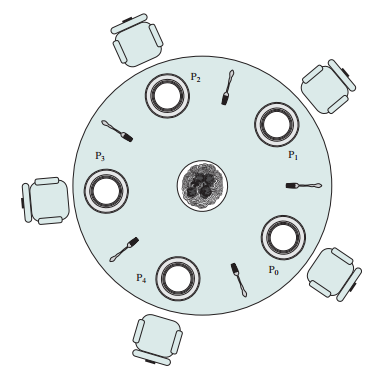
- One or more philosophers sit at a round table. There is a large bowl of spaghetti in the middle of the table.
- The philosophers alternatively eat, think, or sleep. While they are eating, they are not thinking nor sleeping; while thinking, they are not eating nor sleeping; and, of course, while sleeping, they are not eating nor thinking.
- There are also forks on the table. There are as many forks as philosophers.
- Because serving and eating spaghetti with only one fork is very inconvenient, a philosopher takes their right and their left forks to eat, one in each hand.
- When a philosopher has finished eating, they put their forks back on the table and start sleeping. Once awake, they start thinking again. The simulation stops when a philosopher dies of starvation.
- Every philosopher needs to eat and should never starve.
- Philosophers don’t speak with each other.
- Philosophers don’t know if another philosopher is about to die.
- No need to say that philosophers should avoid dying!
Technical considerations:
- Each philosopher should be a thread.
- There is one fork between each pair of philosophers. Therefore, if there are several philosophers, each philosopher has a fork on their left side and a fork on their right side. If there is only one philosopher, there should be only one fork on the table.
- To prevent philosophers from duplicating forks, you should protect the forks state with a mutex for each of them
The bonus rules differ from the previous ones on the following points:
- All the forks are put in the middle of the table;
- They have no states in memory but the number of available forks is represented by a semaphore;
- Each philosopher should be a process. But the main process should not be a philosopher.
./philo[_bonus] number_of_philosophers time_to_die time_to_eat time_to_sleep [number_of_times_each_philosopher_must_eat]examples:
./philo 4 410 200 200
./philo 5 810 200 200 4
./philo_bonus 610 200 200