
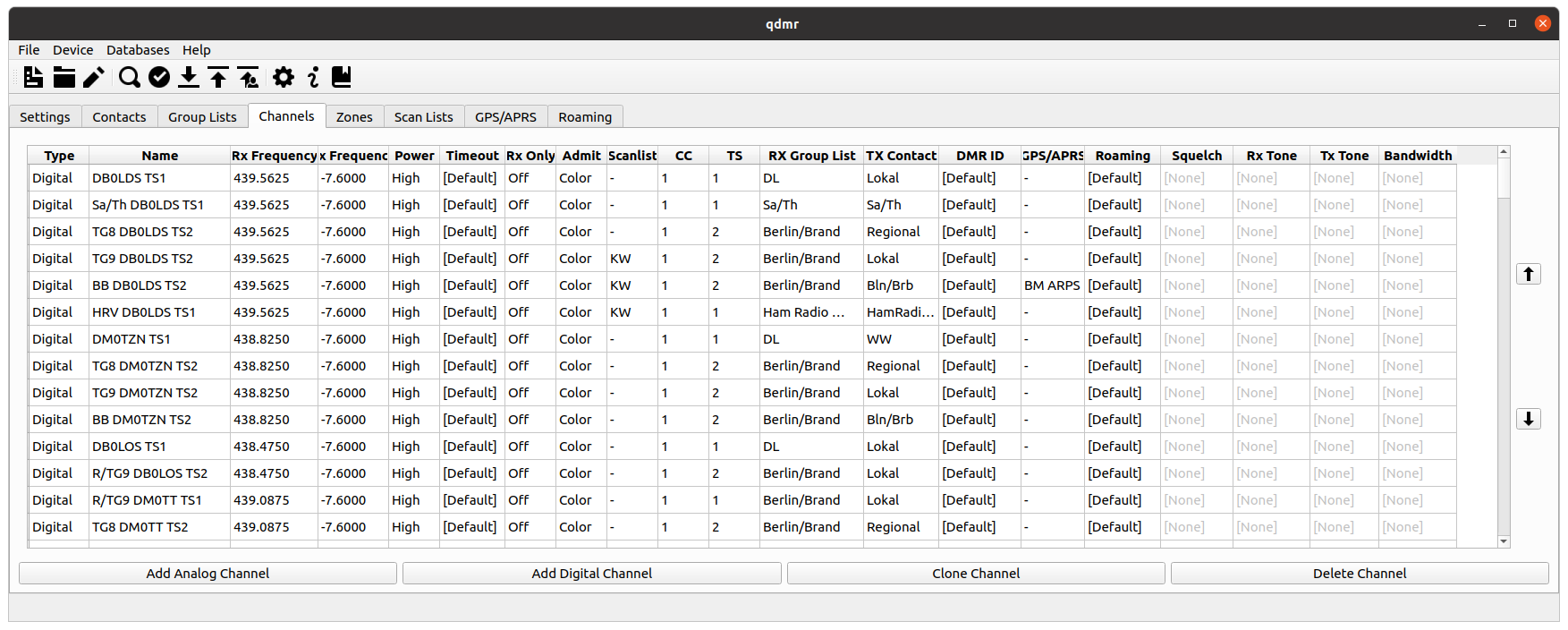
qdmr is a graphical user interface (GUI) application that allows to program several types of DMR radios. To this end, it aims at being a more universal codeplug programming software (CPS) compared to the device and even revision specific CPSs provided by the manufacturers. The goal of this project is to provide a single, comfortable, well-documented and platform-independent CPS for several types of (mainly Chinese) DMR radios.
Currently, there are only few radios that are supported
- OpenGD77, OpenRD5R, etc. firmware (since version 0.4.0)
- OpenUV390, OpenDM1701, etc. firmware (since version 0.13.0)
- Radioddity GD77 (since version 0.8.1)
- Radioddity GD73 (since version 0.12.0)
- Baofeng/Radioddity RD-5R & RD-5R+ (since version 0.2.0)
- TYT MD-390 / Retevis RT8 (since version 0.9.0)
- TYT MD-UV380 (since version 0.9.0)
- TYT MD-UV390 / Retevis RT3S (since version 0.3.0)
- TYT MD-2017 / Retevis RT82 (since version 0.9.0)
- Anytone AT-D878UV (since version 0.5.0)
- Anytone AT-D868UVE (since version 0.7.0)
- Anytone AT-D878UVII (since version 0.8.0)
- Anytone AT-D578UV (since version 0.8.0)
- Anytone AT-D578UV II (since version 0.13.0)
- BTECH DM-1701 / Retevis RT84 (since version 0.10.0)
- BTECH BF-1801A6 (since version 0.12.0)
- BTECH DMR-6x2 (since version 0.11.0)
- BTECH DMR-6x2 PRO (since version 0.13.0)
A more detailed list is also available.
- Have a look at the discussions, maybe your questions has already been answered.
- There is a Matrix chat at #qdmr:darc.de.
- You can also follow me at mastodon, where I usually announce new releases.
- If you find any bugs or have suggestions to improve qdmr, consider opening an issue or participate in one of the discussions.
- If you want to help translating qdmr in your language, checkout qdmr's weblate project.
As qdmr gets more and more popular with Linux HAMs, the ecosystem around it grows too. These are tools, that make your day-to-day usage of qdmr easier, by providing features, not covered in qdmr or dmrconf.
- dmrfill -- Automatically extemds a qdmr YAML file with repeaters from a selected region. Get them all with one single command.
- anytone-emu -- A tool for emulating radios, reverse engineering and documenting codeplugs. Also generates some codeplug documentation.

- Version 0.13.3 -- Bugfix release.
- Version 0.13.2 -- Bugfix release.
- Version 0.13.1 -- Bugfix release.
- Version 0.13.0 -- Added support BTech DMR6X2PRO and OpenUV390.
- Version 0.12.3 -- Added support BTech DR-1801UV (A6, still unstable) and Radioddity GD-73.
- Version 0.11.3 -- Added proper support for BTech DMR-6X2UV, device specific settings for AnyTone devices, some bugfixes.
- Version 0.10.4 -- Added support for BTech DM1701, some bugfixes.
- Version 0.9.3 -- Reworked core library, added support for TyT MD-2017/Retevis RT82, TyT MD-390/Retevis RT8 & TyT MD-UV380.
- Version 0.8.1 -- Fixed Radioddity GD-77 support (callsign db still buggy).
- Version 0.7.0 -- Added AT-D868UVE support and many bugfixes.
- Version 0.6.0 -- Added APRS & roaming for AT-D878UV.
- Version 0.5.0 -- Added support for Anytone AT-D878UV.
- Version 0.4.0 -- Added Open GD77 support.
- Version 0.2.1 -- First public release.
There are several ways to install qdmr on your system ranging from simple app-package downloads to building qdmr from its sources. For a detailed list of instructions for your system, read the install instructions. Some distributions (see badge above) already added qdmr, thus easing the install using the system package manager.
qdmr - A GUI application and command-line-tool to program DMR radios. Copyright (C) 2019-2026 Hannes Matuschek, DM3MAT
This program is free software; you can redistribute it and/or modify it under the terms of the GNU General Public License as published by the Free Software Foundation; either version 3 of the License, or (at your option) any later version.
This program is distributed in the hope that it will be useful, but WITHOUT ANY WARRANTY; without even the implied warranty of MERCHANTABILITY or FITNESS FOR A PARTICULAR PURPOSE. See the GNU General Public License for more details.
You should have received a copy of the GNU General Public License along with this program; if not, write to the Free Software Foundation, Inc., 51 Franklin Street, Fifth Floor, Boston, MA 02110-1301 USA.